


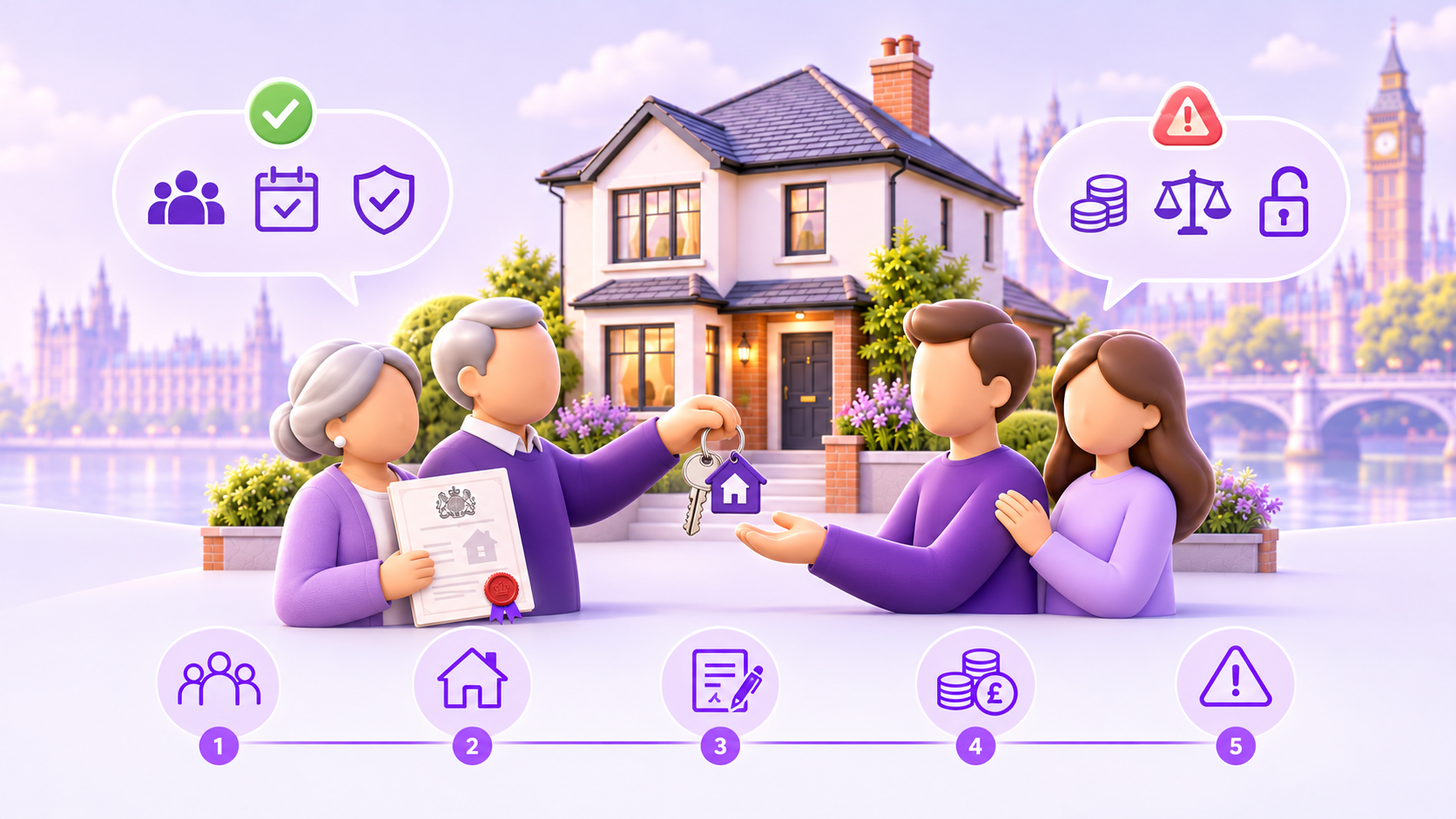
Yes, you can put your house in your adult children’s name, but it rarely works the way people expect. It can reduce Inheritance Tax if you live for seven years and stop benefiting from the home. It will not reliably protect the home from care fees, and once it is gifted, it belongs to your children.
This guide covers England and Wales and reflects the rules as at November 2026.
Why parents consider it
- Helping children onto the property ladder or giving them security now.
- Reducing Inheritance Tax on the family estate.
- Passing the home on without waiting for a will to take effect.
- Worry about care fees using up the value of the home.
The first three can be sensible goals with the right planning. The last one is the reason most likely to backfire.
Pros and cons at a glance
Potential pros
- The home can fall outside your estate for Inheritance Tax if you survive seven years and do not keep benefiting from it.
- There is usually no Capital Gains Tax on gifting a home you have always lived in as your main residence.
- Your children gain a valuable asset now, and you see your gift being used.
- A mortgage-free gift normally has no Stamp Duty and can be a simple HM Land Registry application.
Potential cons
- You lose legal ownership. Your children can sell or mortgage the home, and you have no automatic right to stay.
- If you keep living there rent-free, it usually still counts in your estate for Inheritance Tax.
- Capital Gains Tax may be due straight away on a second home or buy-to-let, and later when your children sell.
- The home is exposed to your children’s divorce, bankruptcy or death.
- The council can still count the home for care fees if it decides you gave it away to avoid charges.
- Unequal gifts between children can cause disputes, and a gift is hard to reverse.
Capital Gains Tax: the parent may pay too
For Capital Gains Tax (CGT), a gift to your child is treated as if you sold the property at its market value on the day of the gift. Parents and children are “connected persons”, so it does not matter that no money changes hands. (GOV.UK)
- Your main home. If you have lived there throughout your ownership, Private Residence Relief usually means no CGT on the gift. (GOV.UK)
- A second home or buy-to-let. CGT may be due on the increase in value, even though you receive nothing.
- Rates. Residential property gains are taxed at 18% within your basic-rate band and 24% above it. The older 28% rate no longer applies. The tax-free allowance is £3,000. (GOV.UK)
- Deadline. Where CGT is due on UK residential property, it generally has to be reported and paid within 60 days of completion. (GOV.UK)
Example: Linda gifts her son a buy-to-let flat worth £300,000 that she bought for £180,000. The gain is £120,000. After the £3,000 allowance, £117,000 is taxable. As a higher-rate taxpayer, she could owe around £28,080 at 24%, with no sale money to pay it from. (Simplified: it ignores costs and other reliefs.)
Your children are treated as acquiring the property at its market value on the date of the gift. If they do not live in it as their main home, any growth in value from that date may be taxable when they sell.
Inheritance Tax and the seven-year rule
A gift of property to your child is usually free of Inheritance Tax (IHT) if you live for seven years after making it. (GOV.UK)
If you die within seven years, the gift is counted. Where gifts exceed the tax-free threshold, taper relief reduces the tax on the excess if you die between three and seven years after the gift:
- less than 3 years: 40%
- 3 to 4 years: 32%
- 4 to 5 years: 24%
- 5 to 6 years: 16%
- 6 to 7 years: 8%
The nil-rate band of £325,000 and the residence nil-rate band of up to £175,000 are frozen until 5 April 2031. (GOV.UK)
The residence nil-rate band applies to a home that passes to children or grandchildren on death. Giving the home away during your lifetime can mean the allowance is not available for it, so for some families, leaving the home in a will is the more tax-efficient option.
Stamp Duty
A gift of a mortgage-free property, where your child pays nothing, is not normally subject to Stamp Duty Land Tax. If your child takes on a mortgage, the debt can count as payment and tax may be due. In Wales, Land Transaction Tax applies instead. (GOV.UK) Our guide to Stamp Duty on transfer of equity explains more.
Living in the home after you gift it
This is where many family plans go wrong.
- Gift with reservation of benefit. GOV.UK gives this exact example: giving your home to a relative but still living there. The home still counts in your estate for IHT, however many years pass. (GOV.UK)
- Paying rent. To avoid this, you would generally need to pay your children a full market rent, reviewed regularly. They then pay Income Tax on it. A separate annual charge, the pre-owned assets tax, can apply to some other arrangements.
- No automatic right to stay. Your child could sell, let or remortgage. The home could be drawn into their divorce or bankruptcy. If they die before you, it passes under their will or the intestacy rules.
There are narrow exceptions, for example where you and your child both live in the home and share the running costs. These need specialist advice.
Care fees and deprivation of assets
Gifting the house is not a reliable way to protect it from care fees.
In England, people with capital above £23,250 usually pay the full cost of a care home. (GOV.UK) In Wales, the residential care capital limit is £50,000. (GOV.WALES) The home can be ignored in some cases, for example while a spouse or partner still lives there.
If the council decides you gave the home away to avoid or reduce care charges, it can treat you as still owning it. This is called deliberate deprivation of assets. The council looks at whether avoiding charges was a significant reason and whether a need for care was foreseeable. (GOV.UK)
There is no fixed time limit. The seven-year rule is an Inheritance Tax rule, not a care-fee rule. In some cases, the council can also seek to recover charges from the person who received the property.
Other checks before you decide
- Means-tested benefits: similar deprivation rules can affect benefits such as Pension Credit.
- Children under 18: they cannot hold the legal title, so a trust would be needed. That needs a solicitor.
- Family fairness: gifting to one child, or unequally, can lead to disputes and claims against your estate.
Alternatives worth discussing with an adviser include leaving the home in your will, gifting a share rather than the whole, a trust, smaller gifts using the £3,000 annual exemption, or a Lasting Power of Attorney if the aim is for your children to manage things if your health declines. Our guide to tenants in common vs joint tenants explains how shares work.
Tax and care rules depend on your circumstances, so take independent advice before you transfer.
How Property Swift can help
Once you have decided to make the gift, Property Swift provides administrative and document support for straightforward, mortgage-free transfers to adult children in England and Wales. We are not a law firm, and we do not give legal or tax advice.
A transfer is most likely to be straightforward when the property is registered and mortgage-free, all current owners agree, the gift is outright to children aged 18 or over, and you are already the registered owner. If you inherited the property, we can help once it is registered in your name.
- Self Service Property Transfer (£650). We check eligibility, review the title register and prepare your HM Land Registry forms from the information you provide. Identity verification is arranged with a UK solicitor. You sign and submit the application yourself, and HM Land Registry fees are extra.
- Solicitor Supported Property Transfer (£795). An independent regulated conveyancer handles the relevant legal work, submits your application to HM Land Registry and deals with its queries. Standard registration fees are included, subject to our terms.
Neither service covers mortgaged properties, gifts to children under 18, trusts or tax and care-fee planning. See our Property Gifting Service and online property transfer process for more.
View Property Transfer Options & Prices
Frequently asked questions
Can I put my house in my children’s name in the UK?
Yes, if your children are 18 or over. The transfer is registered with HM Land Registry. Children under 18 cannot hold the legal title, so a trust would be needed.
Does putting my house in my children’s name avoid Inheritance Tax?
Only if you live for seven years after the gift and stop benefiting from the home. If you keep living there rent-free, it usually still counts in your estate.
Do I pay Capital Gains Tax if I give my house to my children?
Usually not on a main home you have always lived in. On a second home or buy-to-let, CGT may be due at 18% or 24% on the gain, generally reported and paid within 60 days.
Can I still live in the house after gifting it?
Yes, but unless you pay a full market rent, it is likely to stay in your estate for Inheritance Tax. You also have no automatic legal right to remain.
Can the council still count my house for care fees?
Yes, if it decides you gave the home away to avoid care charges. There is no fixed time limit on how far back it can look.
Which Property Swift service should I choose?
Choose Self Service if you’re comfortable signing and submitting the application yourself. Choose Solicitor Supported if you’d like a regulated conveyancer to submit it and handle HM Land Registry’s queries. Our Self Service vs Solicitor Supported guide compares them.



Leave a Comment