


Gifting your house to your children can be an important family decision. You may want to help your children financially, pass on property during your lifetime, or make arrangements as part of wider estate planning.
But giving away a property is not simply a matter of changing a name on the property register.
A property gift can have Inheritance Tax, Capital Gains Tax and property transaction tax implications, particularly where the property is subject to a mortgage. There can also be consequences if you give away your home but continue to benefit from it.
If you are considering gifting a house to your children, understanding these issues before starting the ownership-change application can help you make a more informed decision.
This guide explains the main considerations for property in England and Wales, including the difference between a property gift and a sale, the 7-year Inheritance Tax rule, Gift with Reservation of Benefit, Capital Gains Tax, mortgages, SDLT and Land Transaction Tax.
Can I Gift My House to My Children?
Yes. You can give your house to your children without selling it to them for a conventional purchase price.
However, the gift and the registration of the ownership change are two separate considerations.
If the property is registered, the change in ownership needs to be dealt with through the appropriate HM Land Registry application. HM Land Registry confirms that individuals can apply themselves or use a solicitor or conveyancer to help with the application. It also warns that the process involves legal steps and can be complicated.
The tax position is separate. Depending on the circumstances, gifting your property can have implications for:
- Inheritance Tax
- Capital Gains Tax
- Stamp Duty Land Tax in England
- Land Transaction Tax in Wales
- Mortgage arrangements
- Your continued use of the property
So, before starting a property transfer application, it is important to understand what the gift actually means for you and your children.
What Does It Mean to Gift a Property?
A property gift generally means that you give an ownership interest in a property to another person without receiving a conventional purchase price in return.
For example, you might:
- Give your house to one or more children
- Transfer a share of your property to a child
- Add your child as a joint owner
- Transfer ownership of a property that you no longer want to retain
- Make a property gift as part of wider family or estate planning
A genuine gift does not necessarily create a property transaction tax liability. However, the absence of a cash payment does not automatically mean there are no tax consequences.
The position can change where the recipient takes on an existing mortgage or another form of consideration is involved.
What Should I Consider Before Gifting My House?
Before starting an application, consider the following:
1. Who will own the property after the gift?
Will you give the entire property to one child, divide ownership between several children, or become joint owners with your child?
The ownership structure can affect what happens to the property later.
2. Is there a mortgage?
If there is an outstanding mortgage, the lender and the mortgage arrangements may need to be considered before the ownership changes.
A mortgage can also affect the tax treatment of the transfer.
3. Will you continue living in the property?
If you give your home away but continue living there, the Gift with Reservation of Benefit rules may become relevant for Inheritance Tax.
4. Could Capital Gains Tax apply?
This depends on the property and how it has been used. Your main residence may qualify for Private Residence Relief, while a second home or investment property can have a different treatment.
5. Which property transaction tax applies?
The rules differ between England and Wales.
- England: Stamp Duty Land Tax (SDLT)
- Wales: Land Transaction Tax (LTT)
6. Do you need legal or tax advice?
A property gift can have consequences beyond the Land Registry application. If the arrangement is complicated or intended to achieve a particular tax or estate-planning result, consider obtaining independent professional advice.
What Is the 7-Year Rule for Gifting a House?
The 7-year rule is an important part of the Inheritance Tax treatment of certain lifetime gifts.
Many lifetime gifts to individuals are treated as Potentially Exempt Transfers (PETs). If the person making the gift survives for seven years after making it, the gift can become exempt from Inheritance Tax.
If the person dies within seven years, the gift may become relevant when calculating Inheritance Tax. The tax treatment depends on the value of the gifts, the available tax-free threshold and other circumstances.
It is therefore too simplistic to say:
"Gift the house and survive seven years, so there will definitely be no Inheritance Tax."
The wider estate and other lifetime gifts can matter.
How Does Taper Relief Work?
If Inheritance Tax is due on a gift and the person dies between three and seven years after making it, taper relief can reduce the tax rate applied to the gift.
HMRC currently sets out the following rates:
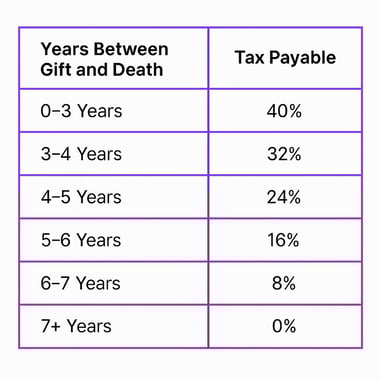
However, taper relief only applies in particular circumstances. HMRC states that it only applies where the total value of gifts made within the seven years before death exceeds the available £325,000 tax-free threshold.
So the table should not be interpreted as a guaranteed tax saving simply because a gift was made more than three years before death.
Inheritance Tax: 7-Year Taper Relief Table (UK)
|
Years Between Gift & Death |
IHT Rate Applied |
Effective Reduction |
|
0–3 years |
40% |
None |
|
3–4 years |
32% |
20% |
|
4–5 years |
24% |
40% |
|
5–6 years |
16% |
60% |
|
6–7 years |
8% |
80% |
|
7+ years |
0% |
Fully exempt |
What Is a Gift With Reservation of Benefit?
A Gift With Reservation of Benefit (GROB) can arise when someone gives away an asset but continues to benefit from it.
This is particularly important when gifting a family home.
For example, imagine you:
- Give your house to your children.
- Continue living in the house.
- Do not pay rent at the going market rate.
- Continue benefiting from the property.
HMRC may treat the property as remaining part of your estate for Inheritance Tax purposes because you have retained a benefit from the gift.
HMRC specifically gives the example of someone giving their home to a relative but continuing to live there without paying rent at the going rate.
Can I Give My House Away and Continue Living There?
Potentially, but the tax consequences need careful consideration.
HMRC's guidance explains that paying rent at the market rate can mean the person has not retained a benefit in the property. However, the wider circumstances matter, and the GROB rules contain specific conditions and exceptions.
If you intend to gift your home while continuing to live there, this is an area where independent professional advice can be particularly important.
Does Capital Gains Tax Apply When I Gift My House?
It can.
Giving property away is a disposal for Capital Gains Tax purposes, even though you may not receive money for it.
The tax treatment depends on factors including the type of property and how it has been used.
For example:
- A property that has been your only or main residence may qualify for Private Residence Relief.
- A second home or investment property may have a taxable gain.
- If the property has been used partly as a home and partly for another purpose, the relief may be restricted.
- Other reliefs or rules may also affect the calculation.
HMRC confirms that Private Residence Relief can apply to a gain on a qualifying main residence, subject to the relevant conditions.
This means you should not assume that gifting a property automatically creates a Capital Gains Tax bill, but you should also not assume there will be no CGT simply because you did not receive payment.
What Happens to the Property's Value for Capital Gains Tax?
For certain transactions that are not made at arm's length, HMRC's Capital Gains Tax rules can require market value to be considered rather than simply using the amount of money received.
This matters because a property gift may involve no payment at all.
If you are gifting a property that is not fully covered by Private Residence Relief, you may need to establish the relevant market value and calculate whether a gain arises.
The rules can become more complicated where the property has been:
- Let to tenants
- Used as a second home
- Used partly as business premises
- Used as your main residence for only part of the ownership period
HMRC's guidance on Private Residence Relief confirms that relief can be restricted where the property has not been used as the owner's only or main residence throughout the relevant period.
If CGT may apply, obtain appropriate tax advice before completing the property gift.
What Happens If the Property Has a Mortgage?
A mortgage can significantly change the position.
Suppose you own a house worth £400,000 with an outstanding mortgage of £150,000 and decide to gift the house to your child.
If your child takes responsibility for the mortgage, the transaction may not be treated in the same way as a gift where there is no debt involved.
For SDLT purposes in England, HMRC explains that taking on liability for an existing mortgage can constitute chargeable consideration.
This means that the mortgage can matter even though you are not receiving a cash payment for the property.
Questions to consider if there is a mortgage
Before starting the application, consider:
- How much is outstanding on the mortgage?
- Who is currently responsible for the mortgage?
- Will your child take on some or all of the mortgage liability?
- Does the lender need to consent to the ownership change?
- Will the mortgage affect SDLT or LTT?
- Are there other charges or restrictions registered against the property?
Do not assume that a property gift is tax-free simply because no money changes hands.
Is Stamp Duty Payable When Gifting a House?
For property in England, Stamp Duty Land Tax (SDLT) is generally based on the amount of chargeable consideration given for the property.
A straightforward gift where there is no chargeable consideration will normally not attract SDLT.
However, HMRC explains that SDLT can apply where the recipient takes over some or all of an existing mortgage and the relevant amount exceeds the applicable SDLT threshold.
For example, if your child receives the property as a gift but takes responsibility for an outstanding mortgage, that mortgage liability may count as chargeable consideration.
The exact SDLT position depends on the circumstances and the applicable rules.
What About Wales?
Wales has a different property transaction tax: Land Transaction Tax (LTT).
The Welsh Government states that property can be gifted or ownership transferred for no chargeable consideration without LTT, but assuming existing debt, such as a mortgage, can constitute chargeable consideration.
Therefore, you should not apply the SDLT rules for England to a property in Wales.
Gifting a House vs Leaving It to Your Children in a Will
There is no universal answer to whether gifting a property during your lifetime is better than leaving it to your children through your will.
The two approaches have different consequences.
Potential reasons to gift during your lifetime
You may want to:
- Give your children ownership while you are alive
- Help a child receive property sooner
- Make a deliberate lifetime gift as part of wider estate planning
- Change the registered ownership while you are still able to manage the process
However, lifetime gifting can also mean giving up control of the property.
Once ownership has changed, your child may become the registered owner and may have rights and responsibilities connected with the property.
Potential reasons to keep the property until death
Keeping the property may allow you to:
- Retain ownership during your lifetime
- Continue living in your home without creating the same GROB issue associated with giving it away and continuing to benefit from it
- Change your estate plans later
- Potentially benefit from different tax treatment on death
The tax treatment of inherited property and lifetime gifts is different, so the best option depends on your circumstances.
For that reason, a property gift should not be viewed simply as a way to "avoid Inheritance Tax".
What Should I Check Before Gifting My House?
Use this checklist before starting a property ownership application.
Property
- Confirm the property's address and title information.
- Check who is currently registered as the owner.
- Determine whether you are gifting the whole property or a share.
Mortgage and charges
- Check whether there is an outstanding mortgage.
- Check whether there are other registered charges or restrictions.
- Contact the lender if the proposed ownership change affects the mortgage.
Tax
- Consider the potential Inheritance Tax consequences.
- Consider whether Capital Gains Tax could apply.
- For property in England, consider SDLT.
- For property in Wales, consider LTT.
- Check whether any debt or mortgage is being transferred.
Your living arrangements
- Decide whether you will continue living in the property.
- If you will remain there, understand the potential Gift With Reservation of Benefit implications.
Your children
- Decide who will become the registered owner.
- Consider whether there will be one owner or joint owners.
- Make sure everyone involved understands the proposed ownership arrangement.
Application
- Gather the required property and ownership information.
- Complete the relevant identity checks where required.
- Review the information and documents before submission.
- Make sure the application is complete before submitting it to HM Land Registry.
How Do I Gift My House to My Children?
The exact process depends on the property and the circumstances of the gift.
For a registered property in England and Wales, the ownership change needs to be registered with HM Land Registry. HM Land Registry confirms that you can apply yourself or use a solicitor or conveyancer to help.
If you choose to complete the application yourself, the process broadly involves the following stages.
Step 1: Check the Property and Ownership
Start by confirming the property details and current registered ownership.
This helps you understand what ownership is currently recorded and what change you want to make.
Step 2: Provide Your Information
Provide the property, ownership and transfer information required for your application.
A guided online platform can help you work through the relevant information in a structured order.
Step 3: Complete Any Required Identity Checks
Identity verification may be required depending on the application and circumstances.
The identity-check process also depends on the service route.
With Property Swift's Self-Service Property Transfer route, Property Swift arranges a video identity verification call with a third-party solicitor.
With the Solicitor-Assisted Property Transfer route, the solicitor conducts identity checks through their own identity check process and link.
These are separate processes and should not be treated as the same form of identity verification.
Step 4: Review and Complete Your Documents
Once you have provided the required information, you can review and complete the documents generated from your input.
Property Swift provides administrative guidance through this process.
You remain responsible for checking the information, completing required signatures or declarations and ensuring that your application is ready for submission.
Step 5: Submit Your Application
You submit your completed application and the relevant supporting information to HM Land Registry through the appropriate process.
HM Land Registry considers the application and can request additional information or corrections where necessary. HM Land Registry itself decides whether and how an application should be registered.
Step 6: The Register Is Updated
If HM Land Registry completes the application, the registered ownership is updated.
Submission does not guarantee that an application will be completed without further action. A requisition or request for additional information can delay completion.
How Property Swift Can Support Your Property Gift Application
If you want to complete your property transfer application yourself but would prefer a more structured online process, Property Swift provides administrative support through its digital platform.
You can:
- Provide your property and ownership information
- Work through a guided application process
- Generate documents from the information you provide
- Review and complete the relevant documents
- Complete the required administrative steps
- Manage your application online
- Submit your application
The distinction is important:
You complete your property application. Property Swift supports the administrative process.
Property Swift does not provide legal advice, act as your solicitor or conveyancer, or make decisions about whether gifting your property is legally or financially appropriate for you.
If you need advice about Inheritance Tax, Capital Gains Tax, SDLT, LTT, your mortgage or the legal consequences of gifting your home, you should seek advice from an appropriately qualified professional.
Is Gifting Your House the Right Choice?
Gifting your home to your children can be appropriate in some circumstances, but it is not automatically the best way to reduce Inheritance Tax or help your family financially.
Before making the decision, consider:
- Whether you can afford to give up ownership
- Whether you need to continue living in the property
- Whether there is a mortgage
- Whether CGT could apply
- Whether SDLT or LTT could apply
- How the gift affects your wider estate
- Whether your children understand the responsibilities of becoming owners
- Whether you need independent legal or tax advice
The ownership application is only one part of the decision.
Understanding the consequences before changing the registered ownership is often more important than simply knowing how to submit the application.
Frequently Asked Questions
Can I gift my house to my children?
Yes. You can give your house to your children without a conventional sale, but the ownership change needs to be dealt with appropriately and registered where required.
The gift may also have Inheritance Tax, Capital Gains Tax, mortgage or property transaction tax implications depending on the circumstances.
Do I pay tax when gifting my house to my child?
You may.
The tax consequences depend on the circumstances of the gift.
Inheritance Tax may be relevant to lifetime gifts, Capital Gains Tax can apply to certain property disposals, and SDLT or LTT may apply where there is chargeable consideration, including certain mortgage arrangements.
What is the 7-year rule when gifting a house?
Many lifetime gifts to individuals can be Potentially Exempt Transfers for Inheritance Tax purposes.
If you survive seven years after making the gift, the gift can become exempt from Inheritance Tax. If you die within seven years, the gift may become relevant to the Inheritance Tax calculation.
Taper relief can reduce the rate of tax in certain circumstances where death occurs between three and seven years after the gift.
Can I gift my house to my children and still live in it?
You may be able to do so, but continuing to benefit from a gifted property can create a Gift With Reservation of Benefit issue.
HMRC specifically identifies giving your home to a relative and continuing to live there without paying rent at the going rate as an example of a gift with reservation.
If you intend to give away your home but continue living there, obtain appropriate professional advice before proceeding.
Is Stamp Duty payable when gifting a house?
In England, a straightforward gift with no chargeable consideration will normally not attract SDLT.
However, SDLT may apply if the recipient takes on an existing mortgage or there is another form of chargeable consideration.
The exact treatment depends on the circumstances.
What tax applies if I gift a house in Wales?
Wales uses Land Transaction Tax (LTT) rather than SDLT.
A gift with no chargeable consideration can be outside the charge to LTT, but assuming existing debt such as a mortgage can create chargeable consideration.
Does Capital Gains Tax apply when I gift my house?
It can.
Capital Gains Tax may be relevant when property is gifted, particularly if it is not fully covered by Private Residence Relief.
A qualifying main residence may benefit from Private Residence Relief, subject to the applicable conditions.
Second homes, investment properties and properties with periods of non-residential use can have different tax treatment.
Do I need a valuation when gifting my house?
A valuation may be relevant depending on the circumstances, particularly where the tax treatment requires the property's market value to be established.
Whether you need a formal valuation depends on why the value is required and the nature of the transaction.
If you are unsure, seek appropriate professional advice.
Can I gift only part of my house to my child?
An ownership interest or share in a property can sometimes be transferred rather than the entire property.
The process and consequences depend on the current ownership structure and the proposed arrangement.
If the property is jointly owned, the type of ownership can also affect what happens to each owner's interest. HM Land Registry explains that joint property can be held as joint tenants or tenants in common, with different consequences.
Can I complete the property transfer application myself?
Yes.
HM Land Registry allows individuals to apply themselves, although it warns that the process involves legal steps and can be complicated. You can also choose to use a solicitor or conveyancer.
A guided online platform can provide administrative support while you complete your own application.
How does Property Swift help me gift my house?
Property Swift provides a digital platform and administrative support to help you complete your property transfer application.
You provide the required information, work through the guided process, review the documents generated from your input, complete the relevant steps and submit your application.
Property Swift does not provide legal or tax advice or act as your solicitor or conveyancer.
What happens after I submit my property transfer application?
HM Land Registry considers the application.
It may request additional information or corrections before completing the registration.
If the application is completed, the registered ownership is updated.
There is no guarantee that an application will be completed without further action.
Is gifting my house better than leaving it to my children in a will?
There is no universal answer.
Gifting during your lifetime can have different Inheritance Tax, Capital Gains Tax and ownership consequences from leaving the property through a will.
A lifetime gift can also mean giving up control of the property, while keeping the property may allow you to retain ownership and use during your lifetime.
If the decision is being made for tax or estate-planning reasons, consider obtaining independent professional advice.
Ready to Start Your Property Transfer Application?
If you have decided that a property ownership change is right for you and want to complete the application yourself,
Property Swift provides a structured online process to help you work through the administrative steps.

Leave a Comment