


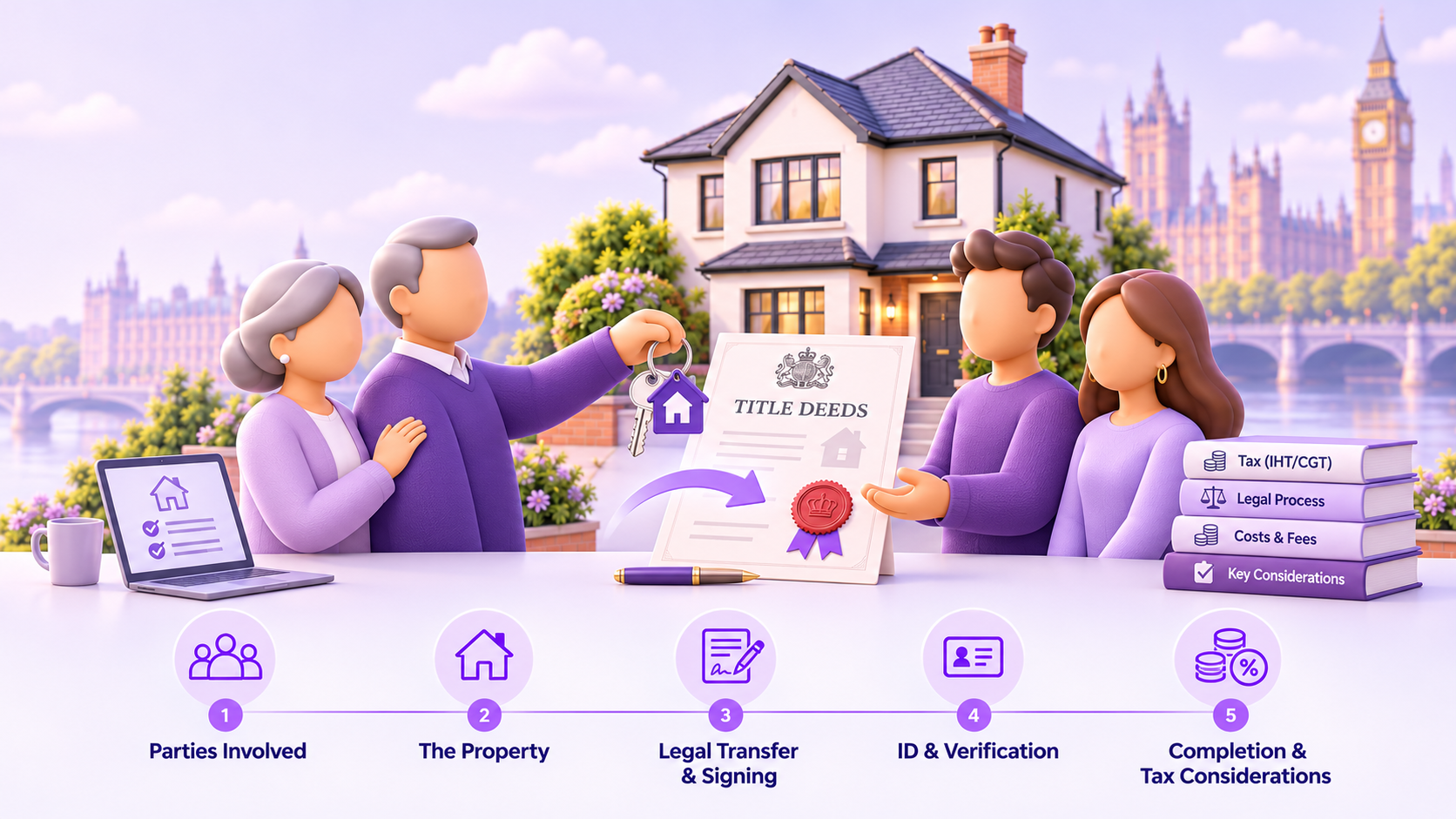
Putting a house in your children's name can be one of the most valuable gifts you make during your lifetime. Whether you want to help your son or daughter onto the property ladder, transfer a family home or plan for the future, it's important to understand how the process works.
The good news is that you can legally transfer a mortgage-free property to your children in England and Wales without selling it, and you don't always need a solicitor to complete a straightforward transfer.
However, there are important considerations, including Inheritance Tax, Capital Gains Tax and the potential consequences of giving away ownership of your home.
In this guide, we explain how to put a house in your child's name, the costs involved, the legal requirements and how Property Swift can help with straightforward property transfers from £650.
Can You Put Your House in Your Children's Name?
Yes. In England and Wales, you can transfer ownership of a property to your children during your lifetime.
There are several ways to do this:
- Gift the entire property: Transfer full ownership of your house to your son or daughter without receiving payment.
- Add your child as a joint owner: Keep an interest in the property while adding your child to the registered ownership.
- Transfer a share of the ownership: Give your child an agreed share of the property.
- Transfer ownership for payment: Sell or transfer the property to your child in return for an agreed amount.
For example, if you own a mortgage-free house and want to transfer it entirely into your daughter's name, this may qualify as a straightforward property transfer. The ownership change must be correctly documented and registered with HM Land Registry.You can read more about the official requirements in the government's guidance on transferring property ownership.
Why Do Parents Transfer Property to Their Children?
Families choose to transfer property for different reasons.
Helping Children Onto the Property Ladder
Gifting a house or share of a property can help a son or daughter secure a home without having to purchase one at market value.
Passing on Property During Your Lifetime
Some parents prefer to transfer ownership while they are alive rather than leave the property through their Will.
This can allow the family to make arrangements earlier, although it does not automatically remove inheritance or tax considerations.
Supporting Family Members Financially
Transferring a property may provide financial security for an adult child or help them establish their independence.
Planning for the Future
Parents may also consider gifting property as part of wider estate planning.
However, transferring ownership purely to reduce inheritance tax or avoid future care costs can have significant legal and financial implications. Professional advice is recommended before proceeding.
Do You Need a Solicitor to Transfer Your House to Your Child?
Not necessarily. A solicitor is not legally required for every straightforward property transfer in England and Wales.
HM Land Registry allows individuals to submit certain property ownership applications themselves. For a straightforward transfer of an entire registered property, the process commonly involves form TR1, which can be used when transferring ownership as a gift. You can find further information in HM Land Registry's official TR1 guidance.
However, some transactions are more complicated and may require a solicitor or licensed conveyancer, particularly where there are mortgages, trusts, complex title restrictions or disputes. For eligible mortgage-free properties, Property Swift offers an alternative to managing all the administrative requirements independently.
Property Swift's Property Transfer Services
| Service | Price | Suitable for |
|---|---|---|
| Self Service Property Transfer | £650 | Eligible straightforward transfers where customers want structured administrative assistance |
| Solicitor Supported Property Transfer | £795 | Eligible transfers where customers want additional conveyancing support and Land Registry submission management |
Both services are designed to make straightforward property ownership changes easier to manage.
Thinking of Putting Your House in Your Child's Name?
If your property is mortgage-free and the ownership transfer is straightforward, Property Swift can help you manage the documentation and administrative process.
Compare our £650 Self Service and £795 Solicitor Supported property transfer options to see which is right for you.
How Do You Transfer a House Into Your Child's Name?
Transferring a house to your son or daughter involves several important stages. While the exact requirements depend on the property, the process typically follows these steps.
1. Check the Property's Ownership and Eligibility
The first step is to establish how the property is currently owned. This includes checking the registered owners, outstanding mortgages, restrictions and any other matters that may affect the transfer.
A straightforward, mortgage-free property with no complex ownership arrangements is generally easier to transfer.
2. Prepare the Property Transfer Documents
The appropriate HM Land Registry transfer documents must be prepared. For example, form TR1 is commonly used to transfer an entire registered property to another person, including as a gift. The documents must accurately reflect the parties involved and the intended ownership change.
3. Complete Identity Verification
Identity verification is an important part of protecting property ownership against fraud. The individuals involved may need to complete identity checks in accordance with HM Land Registry's requirements.
Property Swift can help arrange identity verification as part of its eligible transfer services.
4. Sign the Transfer Documents
The relevant parties must sign the transfer documents correctly. Property transfer deeds commonly require wet-ink signatures and appropriate witnessing. Original signed documents may need to be returned or submitted, depending on the application and submission method.
5. Submit the Application to HM Land Registry
Once the necessary documents are complete, an application is made to HM Land Registry to register the ownership change. With Property Swift's Solicitor Supported service, the Land Registry submission and relevant application queries are managed through the supported process. For Self Service customers, Property Swift provides the document pack and administrative guidance so they can progress the application themselves.
6. Receive Confirmation of the Ownership Change
HM Land Registry reviews the application and, once registration is completed, updates the property register to show the new ownership. Processing times vary depending on the application and HM Land Registry's workload.
Can You Gift Your House to Your Child Without Payment?
Yes. Parents can gift property to their children without receiving payment. This is commonly known as a gifted property transfer or a transfer of property by gift. For example, if you own a house outright and want to give it to your son, the transfer can potentially be completed without a purchase price being paid. However, no money changing hands does not automatically mean the transfer is tax-free. It is important to consider whether the gift could trigger Capital Gains Tax, Inheritance Tax or other legal and financial consequences.
For additional information, see our property gifting service.
Will You or Your Child Pay Tax When Transferring a House?
Tax is one of the most important considerations when putting a house in your children's name. The rules depend on the property's value, the type of ownership transfer and whether any payment or mortgage is involved.
Inheritance Tax: The Seven-Year Rule
If you gift your house to your child and survive for seven years, the gift may fall outside your estate for Inheritance Tax purposes, subject to the relevant rules. However, if you die within seven years, the gift may still affect the Inheritance Tax calculation. There is also an important exception. If you transfer your home to your child but continue living in it rent-free, the property may still be treated as part of your estate for Inheritance Tax purposes. This is known as a gift with reservation of benefit. The government's Inheritance Tax guidance on passing on your home explains how these rules work.
Capital Gains Tax When Gifting Property
Capital Gains Tax may arise when you gift a property, even where your child pays nothing for it. For example, gifting a second home or investment property may trigger a taxable gain based on its market value. If the property has been your main residence, Private Residence Relief may reduce or eliminate the tax liability, depending on the circumstances. HMRC provides further information about Capital Gains Tax and market value.
Stamp Duty Land Tax on Property Gifts
In England, Stamp Duty Land Tax is not normally payable where a property is genuinely gifted without a mortgage or other chargeable consideration. However, SDLT may apply where your child takes responsibility for an existing mortgage or provides other chargeable consideration. You can find more information in HMRC's guidance on SDLT when transferring property. Properties in Wales are subject to Land Transaction Tax rather than SDLT. Property Swift does not provide tax advice. We recommend speaking with a qualified tax adviser before making a significant property gift.
Can You Add Your Child to the House Deeds Without Giving Away the Whole Property?
Yes. You don't necessarily have to transfer your entire property to your child. You may be able to add them as a joint legal owner while retaining ownership yourself. For example, a parent who owns a mortgage-free property in their sole name could transfer it into the joint names of themselves and an adult child. However, there is an important distinction between legal and beneficial ownership.
Joint legal owners do not necessarily own equal beneficial shares, and the way ownership is structured can affect what happens if one owner dies or wishes to sell. Depending on the circumstances, joint owners may hold their beneficial interests as joint tenants or tenants in common. If you are considering unequal shares, trusts or arrangements concerning rights to occupy the property, obtain legal advice before proceeding. For more information, read our guide to transferring property without a solicitor.
What Happens If Your Property Still Has a Mortgage?
Transferring ownership of a mortgaged property is generally more complicated. Your mortgage lender may need to consent to the proposed ownership change, and additional legal arrangements may be required.
In some cases, the lender may require a solicitor or licensed conveyancer to act. Property Swift's standard property transfer services are intended for eligible mortgage-free properties. If your house still has a mortgage, you should speak with your lender and an appropriately qualified conveyancer before proceeding.
How Much Does It Cost to Put a House in Your Child's Name?
The cost depends on whether the transfer is straightforward and whether professional assistance is required.
Traditional conveyancing fees can vary depending on the property and the work involved. For eligible property transfers, Property Swift offers two clear service options.
Self Service Property Transfer — £650
Designed for straightforward, mortgage-free ownership changes. The service includes eligibility screening, title review, preparation of appropriate Land Registry documents, identity verification arrangements and administrative support.
Solicitor Supported Property Transfer — £795
Suitable for customers who prefer additional conveyancing assistance. This service includes support through our partner conveyancing provider, management of the Land Registry submission, application tracking and assistance with relevant Land Registry queries.
Additional charges may apply where requirements fall outside the standard service, and some complex transactions may not be eligible.
Why Choose Property Swift to Transfer Your House to Your Children?
Transferring property to a family member is an important decision, and dealing with unfamiliar Land Registry requirements can feel complicated. Property Swift is designed to make the administrative side of eligible property transfers easier to understand and manage.
Transparent Pricing
Choose from clearly priced transfer services starting at £650.
Convenient Online Process
Begin your application online, securely provide the relevant information and receive guidance about the required documents and next steps.
Identity Verification Support
We help arrange the identity verification process required for eligible transfers.
Choice of Service
Select a self-service solution or solicitor-supported assistance according to your circumstances.
Clear Administrative Support
Our process is designed to help you organise the necessary documentation and understand how your transfer progresses. Property Swift provides property transfer support services rather than independent legal advice. Where specialist legal or tax advice is needed, this should be obtained separately.
How Long Does It Take to Transfer a House to Your Child?
There is no single guaranteed timeframe. The time required depends on the property's circumstances, the documentation involved and HM Land Registry's workload. Straightforward mortgage-free transfers may be simpler to prepare than applications involving mortgages, leasehold requirements or complex ownership arrangements.
However, preparing and submitting a transfer is not the same as HM Land Registry completing the registration.
It's important to allow for the registration process, particularly if the ownership change is needed for a future transaction.
Ready to Put Your House in Your Child's Name?
Property Swift helps parents and families manage straightforward ownership transfers in England and Wales.
Whether you're gifting your house to your son or daughter or adding an adult child as a joint owner, our services provide a clear, structured way to manage the administrative process.
Choose Your Service
Self Service Property Transfer
£650
Solicitor Supported Property Transfer
£795
Find out whether your property is eligible and choose the service that suits your needs.
Frequently Asked Questions
Can I put my house in my child's name and still live in it?
Yes, it may be possible, but continuing to live in a property after gifting it can create important Inheritance Tax consequences. If you continue occupying the property without paying an appropriate market rent, the gift-with-reservation rules may apply. There are exceptions, including certain arrangements involving a gift of only part of a property. Always seek specialist legal and tax advice before transferring a property you intend to continue living in.
Do I need a solicitor to transfer my house to my child?
Not always. Some straightforward ownership transfers can be completed without appointing a solicitor.
However, mortgages, trusts, restrictions, disputes or complex ownership arrangements may make professional legal advice necessary. Property Swift provides administrative support for eligible straightforward transfers, with a solicitor-supported option available.
How much does it cost to transfer a house to my child?
Property Swift's Self Service Property Transfer costs £650, while the Solicitor Supported service costs £795 for eligible transfers. Additional costs may apply depending on the property and circumstances.
Can I gift my house to my child for £1?
A property can potentially be transferred for a nominal amount such as £1. However, this does not automatically avoid tax. HMRC may use the property's market value when assessing certain tax liabilities, and a transfer below market value can still involve a gift.
Will my child have to pay Stamp Duty?
In England, SDLT is not normally payable on a genuine gift where there is no outstanding mortgage or other chargeable consideration. If your child takes responsibility for mortgage debt or provides other consideration, SDLT may arise. Separate Land Transaction Tax rules apply in Wales.
What happens if I die within seven years of gifting my house?
The gift may still be relevant when calculating Inheritance Tax on your estate. The treatment depends on factors including the gift's value, timing and whether you retained any benefit from the property.
Can I add my child as a joint owner without giving away the entire property?
Yes. You can potentially add your child as a joint legal owner. However, legal ownership and beneficial shares are different matters. You should consider how the property will be held and what happens if an owner dies or wants to sell.
Can I transfer a house that still has a mortgage?
Potentially, but your lender's consent and appropriate legal arrangements may be required. Property Swift's standard services are designed for eligible mortgage-free transfers.
Can I transfer my house to more than one child?
Yes. It is possible to transfer ownership to multiple children, although registered legal ownership is generally limited to four people. Where different beneficial shares are intended, additional legal arrangements may be appropriate.
Can I transfer my house to a child under 18?
A child under 18 cannot hold the registered legal estate in England and Wales in their own name in the usual way. Trust arrangements may be possible, but these require specialist legal advice and fall outside Property Swift's standard straightforward transfer services.
How long does HM Land Registry take to register the transfer?
Processing times vary. Some applications are completed relatively quickly, while others can take several months or longer. The time needed to prepare and submit the application is separate from the time HM Land Registry takes to complete registration.
Final Thoughts
Putting a house in your children's name can be a meaningful way to provide long-term support and pass on property during your lifetime. However, it's important to understand the legal and tax implications before giving away ownership, particularly if you plan to remain living in the property.
For eligible, straightforward mortgage-free transfers, Property Swift provides a convenient way to manage the administrative process, with transparent pricing and a choice of support.
Property Swift provides administrative and technology-based support for eligible property transfers in England and Wales. We are not a law firm and do not provide independent legal, tax or financial advice. Complex transactions may require a solicitor or licensed conveyancer.


Leave a Comment