


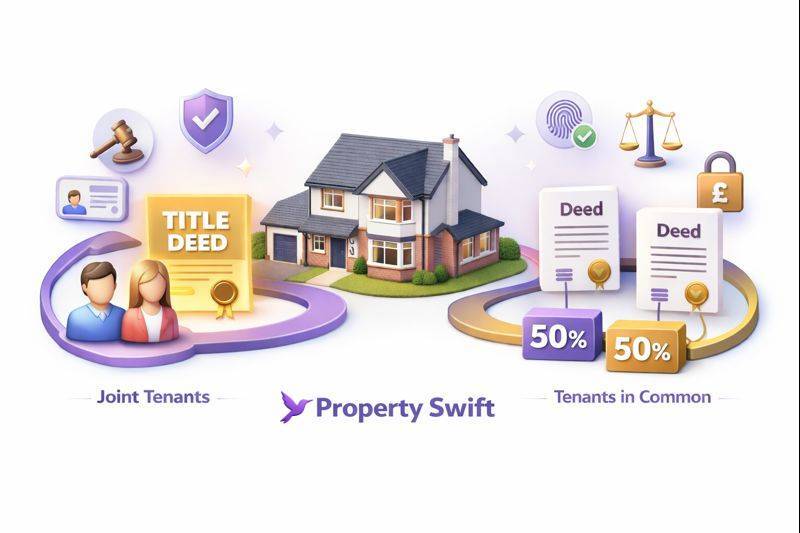
When transferring property ownership in England and Wales, one decision can quietly change inheritance outcomes, tax exposure, and even whether a future transfer can go ahead smoothly:
Should the owners hold the property as Joint Tenants or Tenants in Common?
Many people don’t realise this choice exists—until a transfer, separation, or estate planning decision forces the issue. Understanding the difference before submitting Land Registry forms can prevent costly mistakes later.
The Key Differences
For a quick understanding of how these two ownership structures compare, see the table below.
|
Feature |
Joint Tenants |
Tenants in Common |
|
Ownership Shares |
You own 100% of the property together (no split). |
You own specific shares (e.g. 50/50, 70/30). |
|
If one owner dies |
Ownership passes automatically to the survivor(s). |
Their share passes to whoever is named in their Will. |
|
Can you leave it in a Will? |
No. The "Right of Survivorship" overrides a Will. |
Yes. You have full control over your share. |
|
Best suited for... |
Married couples and civil partners. |
Co-investors, friends, or tax planning. |
What Does “Joint Tenants” Mean?
Joint Tenancy is the most common form of ownership between spouses and long-term partners. In the eyes of the law, you act as a single owner.
Key characteristics:
- All owners own the property together as a whole.
- There are no defined shares.
- If one owner dies, their share automatically passes to the surviving owner(s).
- The property cannot be left to someone else in a will.
When Joint Tenancy is usually suitable:
- Married couples or civil partners.
- Couples buying a family home together with shared finances.
- Situations where automatic inheritance is intended.
Important: This automatic transfer is known as the Right of Survivorship, and it usually overrides any conflicting instructions in a will.
What Does “Tenants in Common” Mean?
Tenants in Common ownership allows each person to own a distinct, specific share of the property. This structure is becoming increasingly popular for modern families and investors.
Key characteristics:
- Ownership is split into defined percentages (e.g. 50/50, 60/40).
- Each owner’s share can be sold, gifted, or mortgaged separately (in theory).
- Shares can be passed on to specific beneficiaries through a will.
-
No automatic transfer on death.
When Tenants in Common is usually suitable:
- Property gifting to children or family members.
- Couples with unequal financial contributions to the deposit.
- Estate and Inheritance Tax (IHT) planning.
- Buy-to-let or investment partners.
- Second marriages where owners wish to leave shares to children from a previous relationship.
Why This Choice Matters During a Property Transfer
When you transfer equity or add a name to a title, the ownership structure you choose directly affects your future rights.
1. Inheritance Outcomes
- Joint Tenants: Automatic transfer to the co-owner.
- Tenants in Common: Follow the instructions in your will.
2. Property Gifting and Family Transfers
Gifting a share of property usually requires you to be Tenants in Common. Without severing a Joint Tenancy first, a gift of a "share" may not be legally effective because, technically, distinct shares do not exist under Joint Tenancy.
3. Divorce or Separation
Joint Tenancy often needs to be "severed" before transferring a share during a separation. Tenants in Common allows for a clean separation of ownership interests, ensuring one partner’s share doesn't automatically go to the ex-partner if they pass away before the divorce is finalised.
4. Tax and Estate Planning
Tenants in Common enables controlled inheritance planning and the use of trusts. This is particularly relevant in 2025, as families increasingly plan ownership changes early to mitigate tax liabilities.
Can You Change from Joint Tenants to Tenants in Common?
Yes—and this is commonly done during a transfer of equity.
The process involves "severing" the joint tenancy. This requires updating the ownership structure and registering a restriction with HM Land Registry. You can read more about the official process on the Gov.uk Joint Property Ownership page.
This must be handled carefully to ensure the Land Registry records match your intentions; otherwise, you may remain Joint Tenants by default.
Common Mistakes People Make
- Assuming ownership type doesn’t matter.
- Forgetting to update ownership during a transfer of equity.
- Believing a will overrides Joint Tenancy (it does not).
- Completing forms without understanding the future implications on care fees or taxes.
These mistakes often only surface years later—when they are expensive or legally difficult to fix.
How Property Swift Helps
Property Swift ensures the correct ownership structure is applied at the point of transfer, not left as an afterthought.
When you use Property Swift to transfer property ownership, we ask you to confirm exactly how you want the property to be held. This allows ownership to be structured correctly during the transfer itself, reducing the risk of inheritance conflicts, ineffective gifts, or future legal corrections.
Our digital process helps you:
- Clearly select between Joint Tenants and Tenants in Common.
- Align your ownership structure with your estate planning intentions.
- Transfer property between joint owners with clarity and compliance.
- Submit accurate applications to HM Land Registry.
By addressing ownership structure upfront, Property Swift helps ensure the Land Registry record reflects your intentions—without unnecessary delays or traditional paperwork.
Frequently Asked Questions (FAQ)
What is the difference between Joint Tenants and Tenants in Common?
Joint Tenants own the property together with automatic inheritance rights (Right of Survivorship). Tenants in Common own defined shares (e.g., 50/50) that can be passed on to different people via a will.
Which ownership type is better for property transfers?
Tenants in Common is typically more suitable for property transfers involving gifting, divorce, or complex estate planning, as the ownership shares are clearly defined and legally separate.
Does a will override Joint Tenancy?
No. With Joint Tenancy, ownership passes automatically to the surviving owner, regardless of what is written in your will.
Can you change from Joint Tenants to Tenants in Common?
Yes. You can change your ownership structure (a process known as "severance") at any time, or ideally during a property transfer, by updating the Land Registry records.
Thinking About Transferring Property?
Start your property transfer with clarity and confidence. We handle the legal details so you can focus on the future.



Leave a Comment