


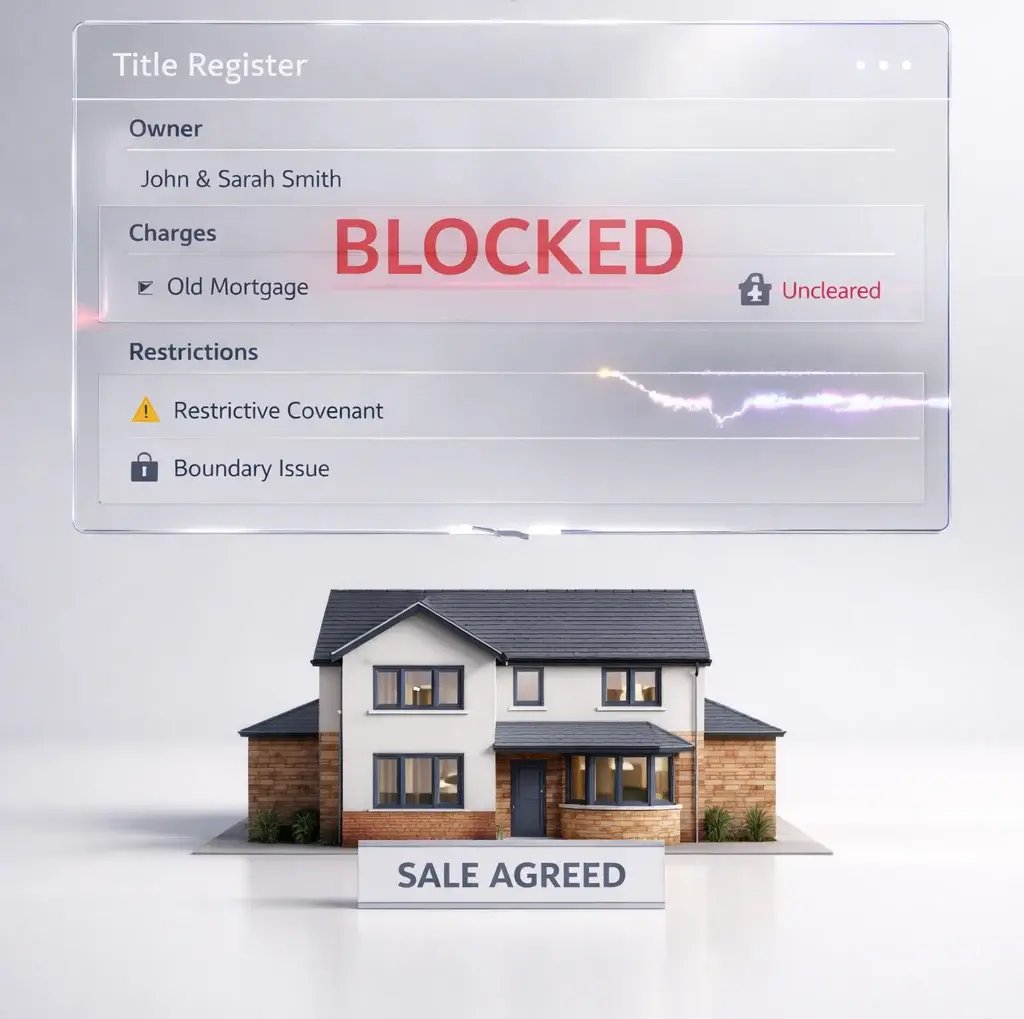
Selling a property should be straightforward. You find a buyer, agree on a price, instruct a solicitor, and move on with your life. But for thousands of UK homeowners every year, the process grinds to a halt not because of the buyer, not because of the market, but because of something buried deep in their Land Registry title.
It is one of the most frustrating and least-talked-about causes of delayed or collapsed property sales. And the worst part? Many sellers have no idea the problem exists until they are already weeks into the conveyancing process.
This guide breaks down exactly what can go wrong with a Land Registry title, why it matters, and most importantly, what you can do about it before it costs you a sale.
What Is a Land Registry Title, and Why Does It Matter?
In England and Wales, His Majesty's Land Registry maintains a central register of all property ownership. When you own a property, that ownership is recorded in a title register, a legal document that proves you have the right to sell.
Your title does more than record your name. It contains the legal description of the land, the boundaries of your property, any rights or restrictions attached to it, and details of any charges (such as a mortgage) secured against it.
When a buyer's solicitor investigates your title, they are looking for anything that might affect the property's value, usability, or the buyer's ability to get a mortgage on it. If they find something they do not like or something incomplete, they will raise a requisition, and the sale stalls.
The frustrating truth is that many of these issues existed long before you bought the property. You may have inherited a problematic title without ever knowing it.
The Most Common Title Issues That Derail Property Sales
1. Restrictive Covenants
A restrictive covenant is a legally binding obligation tied to the land, not just to you as the current owner, but to every future owner. These covenants are often decades or even centuries old, created when land was first developed or sold.
Common examples include restrictions on:
- Using the property for anything other than a single private dwelling
- Building extensions or outbuildings without prior consent from a neighbouring landowner
- Running a business from the premises
- Keeping certain animals on the land
The problem arises when a seller (or a previous owner) has already breached a covenant, perhaps by converting a garage into a living space, building a rear extension, or operating a business from the property. A buyer's solicitor will flag this immediately, and many mortgage lenders will refuse to lend against a property with an unresolved covenant breach.
The solution is usually indemnity insurance, which protects the buyer (and future owners) against any claim arising from the breach. However, for this to work, the covenant breach must not have been acknowledged in writing, which is why, if you suspect a covenant issue, it is crucial not to contact the beneficiary of that covenant before insurance is in place.
2. Missing or Absent Title Deeds
For properties registered before the digital era, some historical documents simply no longer exist. If a property was registered based on old paper deeds that have since been lost, damaged, or destroyed, the Land Registry title may contain gaps that a buyer's solicitor cannot reconcile.
This is particularly common in:
- Older properties that have passed through multiple generations without formal probate
- Properties that were previously unregistered and only became registered as part of a sale or remortgage
- Properties affected by historical events, such as the Second World War, during which many records were lost
Depending on the nature of the gap, your solicitor may need to apply to the Land Registry for a correction, obtain a statutory declaration from someone with personal knowledge of the title's history, or arrange indemnity insurance to cover any potential claim arising from the uncertainty.
3. Boundary Disputes and Unclear Boundary Lines
The Land Registry's title plan, the official map of your property, is drawn from Ordnance Survey data and is generally only accurate to within a general boundary. It is not a precise measurement of where your land begins and ends.
This becomes a serious problem when:
- A neighbour disputes ownership of a strip of land, a shared driveway, or a garden boundary
- The physical boundary features (walls, fences, hedges) do not match what is shown on the title plan
- A previous extension or outbuilding has been built across or close to what another party claims is their land
Even a relatively minor boundary ambiguity can be enough to cause a buyer's mortgage lender to refuse to proceed, particularly if the disputed strip includes part of the house's main structure.
Resolving a genuine boundary dispute can be a lengthy and expensive process. If a dispute is ongoing, you must disclose it in your property information responses, and most buyers will walk away. Prevention is far better than cure: if you are aware of any boundary ambiguity, address it years before you intend to sell.
4. Overreaching Rights and Easements
An easement is a right that another party has over your land, for example, a right of way, a right to run services (gas, electricity, water, drainage) across your property, or a right of access for maintenance purposes.
Most easements are entirely normal and will not prevent a sale. Problems arise when:
- An easement that should be registered on the title is missing, for example, a drainage pipe that runs under your garden without any formal recorded right
- A new easement has been created informally by long use (prescriptive easement), but has never been formally documented
- A right-of-way exists over your property that significantly restricts its use or development potential
Buyers and their solicitors are rightly cautious about unregistered easements. If your neighbour's drainage has run under your garden for thirty years with no formal documentation, a buyer's lender may want the position formalised before they are willing to lend.
5. Chancel Repair Liability
This is one of the more obscure title issues, but it catches sellers off guard with surprising regularity. Chancel repair liability is an ancient obligation dating back to medieval ecclesiastical law, which can require landowners in certain parishes to contribute to the cost of repairing the chancel (the area around the altar) of the local Church of England church.
Since 2013, chancel repair liability must be registered as a land charge to be enforceable. However, for properties sold or remortgaged before that date, the liability may still run with the land if it was already registered at the time.
If your title search reveals potential chancel repair liability, indemnity insurance is usually the most practical solution.
6. Issues With Leasehold Titles
If you are selling a leasehold property, the complexity multiplies significantly. Leasehold titles carry their own set of potential issues:
Short leases — A lease with fewer than around 80 years remaining is very difficult to mortgage, making it almost impossible for most buyers to purchase. If you have not yet extended your lease, this needs to be addressed well before you market the property.
Absent or uncontactable freeholders — In some cases, the freehold is owned by a company that has dissolved, or an individual who cannot be traced. This makes obtaining consent for alterations, extending the lease, or exercising the right to manage extremely difficult.
Service charge and ground rent disputes — Any outstanding disputes with the freeholder or management company will need to be disclosed and resolved. Escalating ground rent clauses are now largely prohibited in new leases following the Leasehold Reform (Ground Rent) Act 2022, but remain a serious issue for older leasehold properties.
Missing building safety documentation — Since the introduction of new requirements following the Grenfell Tower tragedy, buyers of flats and apartments in taller buildings require extensive documentation relating to fire safety, cladding, and building structure. If this documentation is not in place, a sale to a mortgage buyer may be impossible.
7. Charges That Have Not Been Formally Discharged
When a mortgage is repaid in full, the charge over the property should be formally removed from the Land Registry title. In most cases, this happens automatically. But occasionally, particularly with older mortgages, smaller lenders, or lenders that have since merged, been acquired, or ceased trading, the charge is never formally removed.
A buyer's solicitor will require evidence that any charge registered against your property has been fully discharged. If the lender no longer exists, obtaining that evidence can be an involved process, requiring contact with the successor organisation or an application to the Land Registry.
How to Identify Title Issues Before They Become a Problem
The single most effective thing you can do is commission a title review before you put your property on the market.
Ask your conveyancing solicitor to conduct a pre-sale title investigation. They will obtain official copies of your register entries and title plan from the Land Registry, review them for any issues, and advise you on what, if anything, needs to be resolved before a buyer's solicitor sees them.
This costs relatively little compared to the price of a delayed or collapsed sale, and it gives you the time to resolve issues on your terms, rather than under the pressure of a buyer threatening to withdraw.
What to Do If a Title Issue Is Found
Do not panic. The majority of title issues that arise during conveyancing are resolvable. The key is speed and transparency.
Work closely with your solicitor to understand the nature and severity of the issue. In many cases, particularly for historic covenant breaches, missing documentation, or chancel repair liability, indemnity insurance is a quick, cost-effective solution that satisfies both the buyer and their mortgage lender.
For more complex issues, boundary disputes, absent freeholders, or short leases, the resolution process will take longer, and it is worth being upfront with your buyer about what is involved. Most buyers, if they are genuinely committed to the property, will wait for a reasonable resolution. What they will not tolerate is surprises.
A Note on Unregistered Land
Not all property in England and Wales is registered with the Land Registry. Whilst first registration has been compulsory on sale since 1990, some properties, particularly those that have remained in the same family for many generations without being sold or mortgaged, may still be unregistered.
Selling unregistered land requires the seller to prove their title through a chain of original deeds and documents. If those documents are incomplete or missing, establishing a good root of title can be a significant undertaking. If you believe your property may be unregistered, this is something to address with a solicitor as early as possible.
The Broader Lesson: Title Health Is Part of Property Maintenance
Most homeowners diligently maintain the physical fabric of their property, repairing roofs, updating kitchens, and maintaining gardens. Far fewer think about the legal health of their title.
Yet a well-maintained, legally clean title is every bit as important as a well-maintained building when it comes time to sell. Title issues do not resolve themselves over time if anything, they tend to become more complicated as further transactions occur and memories fade.
If you have made alterations to your property, taken in a strip of neighbouring land, varied any lease terms informally, or if your property has been in your family for many decades, it is worth having a solicitor cast a professional eye over your title. Not in anticipation of any immediate problem, but as prudent housekeeping.
When the time comes to sell, you will be glad you did.
Key Takeaways
- Your Land Registry title contains the legal framework that governs what can be done with your property, and who can buy it.
- Common title issues, including restrictive covenants, boundary ambiguities, old charges, and leasehold complications, can delay or collapse a sale.
- Most issues are resolvable, but they are far easier and less expensive to address before a buyer is involved.
- A pre-sale title review with an experienced conveyancing solicitor is one of the smartest investments a seller can make.
- Leasehold sellers in particular should review lease length, ground rent provisions, and building safety documentation well in advance of marketing.
If you are planning to transfer a property in England or Wales and would like to understand the current state of your title, speak to us via the Contact Us form or WhatsApp us directly. We will advise you on any steps that should be taken before you proceed to market.
How Property Swift Can Help You
If reading this article has prompted a nagging concern about your own title or if you already know there is something that needs updating, Property Swift offers a fast, fully online platform designed to make exactly these kinds of title matters straightforward.
Property Swift connects directly to HM Land Registry through the official Business-e-Services Portal, which means everything is handled digitally, accurately, and without the need for office visits or mountains of paperwork.
Here is how they can specifically help when your title is causing problems:
Official Copy of the Title Register and Title Plan. Before anything else, you need to know exactly what your title says. Property Swift can obtain an official copy of your Title Register and Title Plan quickly — giving you and your solicitor a clear picture of the current legal position, any charges registered against the property, and the recorded extent of your boundaries. This is often the essential first step in identifying what needs to be resolved before you market.
Updating Your Name on the Title. If your name has changed since you purchased the property through marriage, divorce, or deed poll, and the title still reflects your former name, a buyer's solicitor will flag this. Property Swift's Change of Name service handles the update with HM Land Registry efficiently, ensuring the register accurately reflects who you are today.
Property Transfer and Ownership Changes. Whether you need to transfer a property into joint names, remove a name following a separation, or gift a property to a family member before a sale, Property Swift handles the entire transfer process online. Their transfer specialists manage the necessary checks and documentation, liaising directly with HM Land Registry on your behalf.
Keeping Your Correspondence Address Up to Date. An outdated correspondence address on the title register means important notices from the Land Registry, from a neighbouring landowner, or relating to any charges, may never reach you. Property Swift can update or add a correspondence address to your register entry quickly and correctly.
Why It Matters
Many of the title issues that stall property sales are not complex legal disputes; they are administrative oversights that have been left unaddressed for years. A name that was never updated. A correspondence address that still shows a property sold a decade ago. An official copy of the title that has never been checked since purchase.
Property Swift exists to make sorting these things out simple. Their platform is built around the reality that most people are not property lawyers, and they should not have to become one to get their title in order.
If you are preparing to sell, or simply want peace of mind that your title is clean and up to date, visiting propertyswift.co.uk is a sensible place to start.


%20Smiling%20parent%20handing%20over%20a%20small%20glowing%20house%20icon%20to%20an%20adult%20child.%20Child%20looks%20happy%20and%20secure.%20Right%20side%20(Cons)%20Worried%20parent%20sitting%20at%20a%20desk%2c%20looking%20anxious%20as%20a%20child%20in%20background%20sign.webp?width=352&name=Left%20side%20(Pros)%20Smiling%20parent%20handing%20over%20a%20small%20glowing%20house%20icon%20to%20an%20adult%20child.%20Child%20looks%20happy%20and%20secure.%20Right%20side%20(Cons)%20Worried%20parent%20sitting%20at%20a%20desk%2c%20looking%20anxious%20as%20a%20child%20in%20background%20sign.webp)
Leave a Comment