


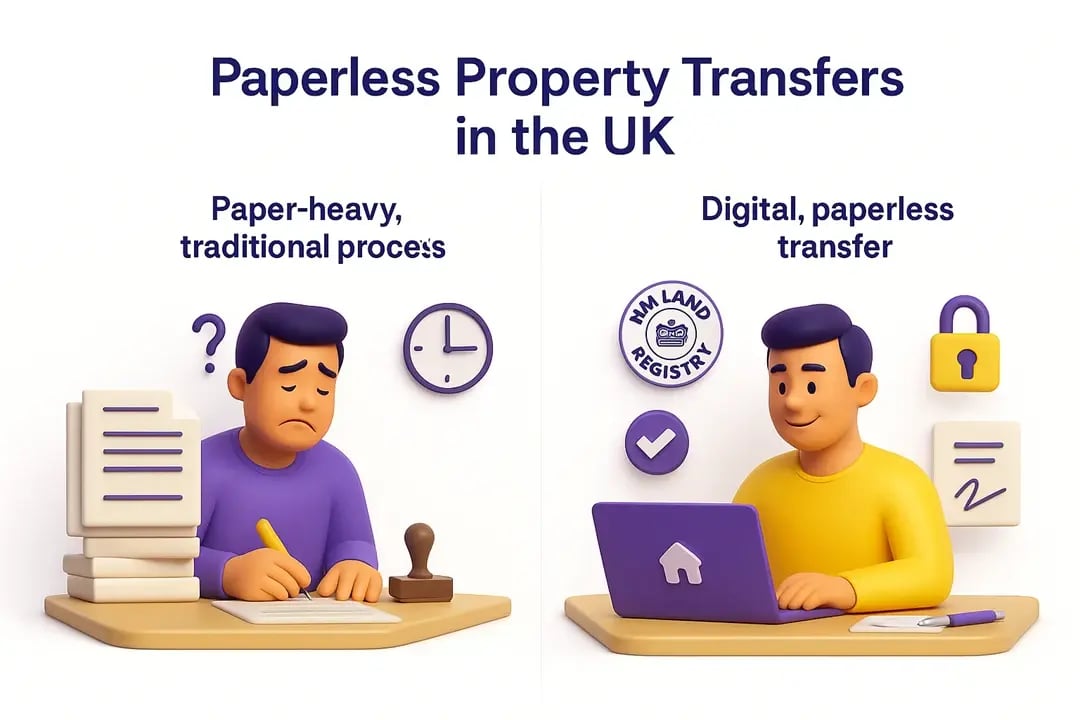
Property ownership in the UK is changing. What once required stacks of paperwork, repeated office visits, and long postal delays can now be handled securely online.
Paperless property transfers are no longer a novelty - they are becoming the standard across England and Wales. For homeowners updating ownership after divorce, gifting property, removing a joint owner, or restructuring assets, digital processes now offer a faster and more transparent alternative to traditional methods.
This guide explains what paperless property transfers really mean in 2026, how they work under current HM Land Registry requirements, and why more property owners are choosing a digital-first approach.
What Does “Paperless” Mean in Property Transfers?
“Paperless” does not mean the legal process disappears. It means the preparation, verification, and submission stages are handled digitally, reducing unnecessary physical documentation.
In practice, this means:
-
Ownership details are submitted online through secure portals
-
Identity checks are completed using regulated digital verification technology
-
Documentation is prepared electronically
-
Only the final execution stage requires a physical signature, as required by HM Land Registry
This hybrid structure ensures full legal compliance while significantly improving speed and clarity.
The legal framework for property registration in England and Wales - governed by the Land Registration Act 2002 and HM Land Registry’s digital practice standards - allows for digital preparation and secure electronic submission, provided formal execution requirements are met.
Why UK Homeowners Are Moving Away from Traditional Paper Transfers
Traditional property transfers were built around physical documents, manual verification, and postal correspondence. While legally sound, they are often slow and prone to avoidable delays.
Digital transfers address these long-standing friction points.
1️⃣ Faster Processing
-
Postal turnaround times are eliminated.
-
Documents are reviewed instantly.
-
Corrections can be made without restarting the entire process.
Although final registration times still depend on HM Land Registry workloads, digital preparation significantly reduces pre-submission delays.
2️⃣ Reduced Risk of Errors
Manual paperwork increases the likelihood of incomplete fields, incorrect names, or missing documentation.
Digital platforms can:
-
Flag missing information before submission
-
Validate ownership details against official records
-
Standardise formatting
Fewer mistakes at the submission stage means fewer requisitions later.
3️⃣ Real-Time Visibility
In traditional processes, clients often have limited insight into progress.
Digital platforms allow:
-
Live status tracking
-
Clear milestone updates
-
Transparent communication
This visibility reduces uncertainty - one of the most common frustrations in property administration.
4️⃣ Stronger Data Security
Property transfers involve sensitive data: identification documents, addresses, financial information, and ownership history.
Modern digital platforms use:
-
Encrypted servers
-
Secure authentication protocols
-
Audit trails
-
Access controls
When implemented correctly, digital systems can be more secure than physical document storage.
5️⃣ Accessibility From Anywhere
Property owners no longer need to visit offices or rely on physical mail.
Transfers can be initiated and monitored remotely - particularly valuable for:
-
Overseas property owners
-
Investors
-
Individuals with mobility constraints
Environmental Impact: A Practical Sustainability Benefit
Property transactions traditionally generate significant paper use - copies, certified documents, and courier deliveries.
Digital preparation reduces:
-
Printing
-
Postal transportation
-
Physical storage
While the legal system still requires certain physical elements, the overall environmental footprint is materially lower.
Sustainability is increasingly influencing property sector practices, and digital transfers align with broader UK digital transformation initiatives.
How a Paperless Property Transfer Works (2026 Framework)
Here is how the modern process typically unfolds:
Step 1 - Secure Online Submission
Ownership details and supporting information are uploaded through a secure portal.
Step 2 - Digital Identity Verification
Identity checks are conducted using regulated digital verification systems aligned with UK anti-money laundering standards.
Step 3 - Electronic Document Preparation
Ownership documents are drafted and reviewed digitally.
Step 4 - Formal Execution
Where required, the final document is physically signed to meet Land Registry execution standards.
Step 5 - Submission to HM Land Registry
The application is submitted electronically for official registration and record update.
The key shift is not the removal of legal safeguards - it is the removal of inefficiencies.
Core Benefits of Paperless Transfers
✨ Speed
Digital preparation shortens timelines before submission.
✨ Accuracy
Structured digital forms reduce administrative errors.
✨ Transparency
Clients can see progress clearly at each stage.
✨ Compliance
Processes remain aligned with HM Land Registry requirements.
✨ Security
Encrypted systems protect sensitive ownership data.
✨ Predictability
Clear digital workflows reduce unexpected administrative setbacks.
The Future of Property Transfers in England and Wales
The UK property sector is steadily transitioning toward digital-first infrastructure.
Key drivers include:
-
Improved efficiency
-
Greater transparency
-
Enhanced fraud prevention measures
-
Environmental considerations
-
Broader government digital transformation goals
Paperless property transfers are not a shortcut - they are a refinement of an established legal system using modern tools
Why Digital Property Transfer Specialists Matter
Not all property changes require full conveyancing. In cases where ownership updates are administrative rather than transactional, digital transfer specialists can provide a focused, streamlined solution.
A properly structured digital platform should offer:
-
Clear process guidance
-
Transparent pricing
-
Compliance with HM Land Registry standards
-
Secure identity verification
-
End-to-end digital case management
-
The value lies in clarity, not complexity.
Final Thoughts
Paperless property transfers represent a practical evolution of UK property administration.
They maintain legal safeguards while reducing unnecessary friction. They improve clarity without compromising compliance. And they reflect the broader digital shift taking place across financial and legal services.
For property owners seeking a faster, structured, and secure way to update ownership records, digital-first transfers are no longer experimental - they are increasingly expected.
The future of property transfers is here - and it’s paperless.
👉 Start your secure, paperless transfer today with Property Swift.
Frequently Asked Questions About Paperless Property Transfers
Are paperless property transfers legally recognised in the UK?
Yes. Digital preparation and electronic submission are permitted under current HM Land Registry procedures. Where required, formal signatures must still comply with execution standards.
Does paperless mean fully electronic signatures?
Not entirely. While much of the process is digital, certain documents may still require physical signatures depending on regulatory requirements.
Is the process secure?
Reputable digital transfer platforms use encryption, identity verification technology, and secure data storage to protect personal and property information.
How long does a digital transfer take?
Preparation is typically faster than traditional methods. Final registration timelines depend on HM Land Registry processing times.
What is a paperless property transfer in the UK?
A paperless property transfer is a digital-first process where ownership documents are prepared, verified, and submitted electronically, while still meeting HM Land Registry’s legal execution requirements.
Are paperless property transfers legal in England and Wales?
Yes. Digital preparation and electronic submission are permitted under current Land Registry rules, provided formal signature requirements are satisfied.
Do paperless property transfers require physical signatures?
In many cases, yes. Although most of the process is digital, certain documents still require physical execution to meet registration standards.
Are digital property transfers secure?
When handled through regulated platforms using encrypted systems and digital identity verification, paperless transfers are highly secure.
Is a paperless transfer faster than traditional conveyancing?
Digital preparation typically reduces administrative delays before submission, though final registration times depend on Land Registry processing schedules.


Leave a Comment